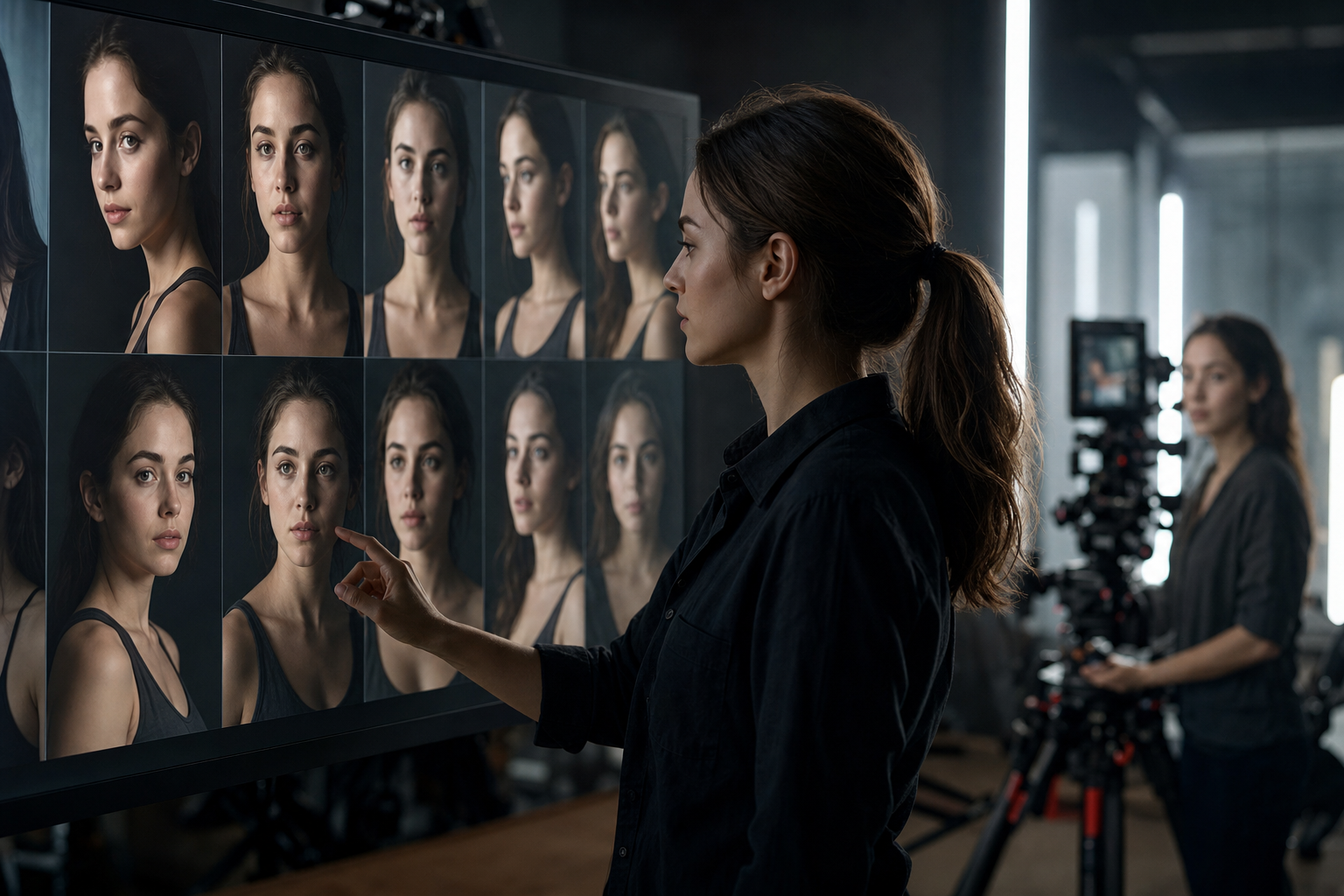
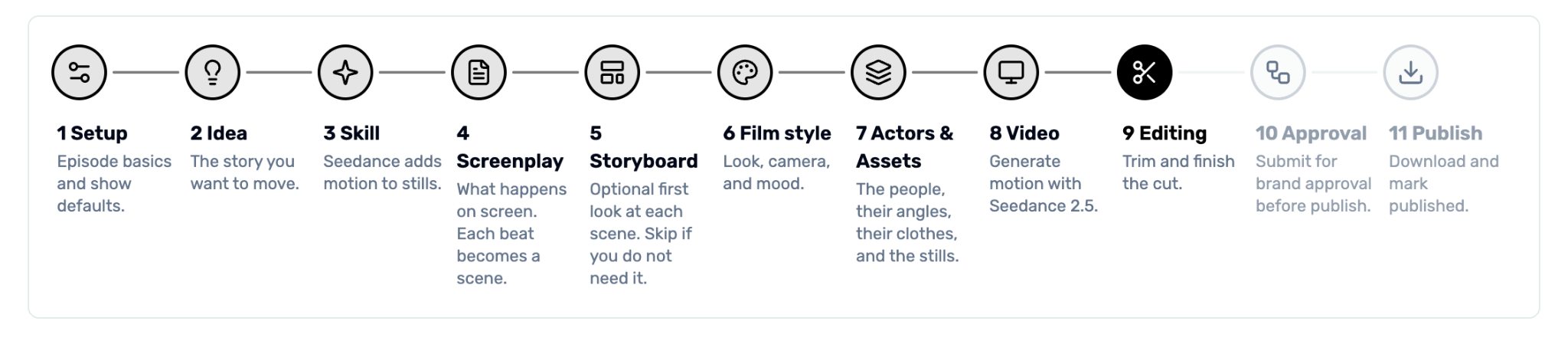
We are getting close to a world where a small team can produce an entire drama without cameras, locations or traditional actors.
Write the story.
Create the characters.
Generate the scenes and voices.
Edit.
Publish.
Sounds simple—until you create your first actor.
Before producing an AI microdrama, you need to answer a fundamental question:
Who exactly is your actor?
Is it:
a fictional person generated by AI?
a reusable digital character created inside a platform?
you?
a real actor who has consented to the use of their likeness?
an AI-generated face created in one platform and animated in another?
These options may look similar, but technically they are not. The distinction becomes critical when you build a series rather than a single video.
The actor is becoming an asset
In traditional filmmaking, you cast an actor. In AI filmmaking, you increasingly create an identity asset.
That asset may include:
face and body
multiple angles and expressions
wardrobe
voice
character reference sheets
identity embeddings
previous generated scenes
You then reuse it across dozens or hundreds of generations. This helps solve one of generative video’s hardest problems: character consistency.
But platforms must also distinguish fictional AI characters from real people. They cannot always do that from pixels alone.
I encountered this while working with Seedance. Our characters were entirely AI-generated, yet some images were rejected with:
InputImageSensitiveContentDetected.PrivacyInformation
The system believed they might contain real people. That is understandable: a photorealistic AI portrait can look identical to a photograph of an unknown person.
The platform therefore needs more than an image. It needs provenance—information about where the identity came from and whether its use is authorized.
That makes the first production decision more important than it may appear:
What kind of actor are you creating, and which platform will own or verify that identity?
Four actor architectures
For a microdrama, it helps to think in terms of four main actor architectures, plus one emerging category.
Actor architecture | Example | Best use |
Fully synthetic actor | AI-generated fictional human | Original fictional series |
Platform character | BytePlus digital character or avatar library | Prototypes and fast production |
Persistent AI identity | Higgsfield Soul ID or similar character asset | Recurring characters |
Authorized human actor | Real actor with documented consent | Commercial productions involving performers |
A fifth category is emerging:
Verified self-avatar
Google’s Personal Avatar is an example. These systems connect a generated identity to an authenticated person rather than treating a reference image as an isolated file.
The right choice depends on what you are making.
A platform character may be ideal for a prototype. A persistent AI identity may be better for a long-running series. An authorized human actor may be necessary when the production depends on a real performer. A fully synthetic actor may offer the greatest creative control, but only if you can preserve its provenance across the tools you use.
Platform workflows
The platforms do not handle actors in the same way. Some emphasize provenance, some persistent identity, and others rights and consent.
Seedance: three ways to have an actor
BytePlus documents three supported routes for portrait creation with Seedance 2.5
1. Trusted ModelArk-generated actors
You can generate a character inside the BytePlus ecosystem using a supported model, such as Seedream 5.0 Lite text-to-image.
The key point is not simply that the image is AI-generated. BytePlus knows it generated the image, so the original output can be passed into Seedance 2.5 without triggering the same face moderation.
There are restrictions. The output must come from ModelArk, be generated under the same account, remain unedited and stay within the current 30-day trust period. Editing, compressing, forwarding, cross-account use or cross-platform use can invalidate that trust.
Your actor therefore has provenance. It is not enough for you to know the character is fictional; the receiving system must be able to verify where it came from.
2. Preset digital characters
BytePlus also provides a library of digital characters: pre-approved synthetic actors you can use in a production.
This is useful for prototypes or disposable content, but the character is not really yours. That matters if you are building a 40-episode series in which the protagonist becomes part of your intellectual property.
3. Authorized real people
The third option is a real person. BytePlus supports authorized real-person portrait assets.
The issue is not that AI video cannot contain real people. The issue is that the platform needs a way to establish that you are authorized to use the likeness.
For professional productions, actor consent is becoming part of the technical workflow, not just paperwork stored elsewhere.
Higgsfield: identity as a creative tool
Higgsfield builds character consistency more directly into its workflow.
Its Soul ID system learns an identity from multiple photographs and lets you reuse that character across supported models and generations. For fictional characters, Higgsfield recommends creating the character first, then producing a reference sheet before generating the film.
Its avatar workflow supports:
library avatars
generated faces
your own likeness
people who have given consent
In practice, that means three categories:
Synthetic actor
Create a fictional face and establish it as a reusable characterPlatform actor
Use an avatar supplied by Higgsfield.Real actor
Use yourself or someone who has authorized the use of their likeness.
Higgsfield’s advantage is that you are establishing an identity rather than repeatedly passing around a JPG.
However, platform capabilities and programme rules are not always the same. A specific competition or model may require entirely fictional characters even if the broader platform supports consented avatars.
Google/Gemini: verified personal avatars
Google is taking a different approach with Personal Avatar.
You record your face and voice, and Google creates an avatar associated with your account. That avatar can then be referenced when generating images and Gemini Omni videos.
Instead of saying, “Here is a photograph—trust me, that’s me,” the system can establish that the identity belongs to the authenticated user who created it.
Personal Avatar is currently unavailable in the UK, EEA and Switzerland.
Gemini also accepts uploaded reference images for video generation, but Google requires you to have the necessary rights and not violate another person’s privacy or other rights. Its policies address consent for personal data and biometrics, as well as deceptive impersonation.
Google’s SynthID adds another layer by embedding an invisible watermark in AI-generated media and helping identify content created or edited by Google’s models.
Provenance is therefore moving in two directions:
Who was the input actor?
and
Which system generated the resulting video?
Runway: references and rights
Runway takes a more conventional approach. It supports character and talent reference images, including workflows that accept a characterImage for the person appearing on camera.
But responsibility remains with the creator:
You need the rights and consent to use the person’s likeness.
Runway moderates both inputs and outputs. Unlike Seedance’s trusted-output mechanism, it does not appear to offer a comparable way to guarantee that a reference generated by a particular model will bypass face moderation.
The model is straightforward:
You provide the reference, you must have the rights, and Runway still moderates the request.
Voice requirements are stricter. For custom voice training, Runway requires the person whose voice is being used to record an explicit consent statement. It does not permit unwanted voice replicas, including those made from recordings of public or private figures.
Again, authorization is becoming part of the product itself.
The portability problem
Once you choose an actor architecture and establish an identity inside a platform, the next question is whether that identity can travel.
This is the central challenge for AI filmmaking.
Imagine creating MARIA: 31, dark-haired, Greek, with distinctive eyes and a specific facial structure. You generate 200 images, create her voice, build a character sheet and produce ten episodes.
To you, Maria is clearly fictional. But what happens when you move her between providers?
Seedream to Seedance may preserve her provenance. Higgsfield may recognize her through Soul ID. Gemini may understand an identity verified through its own avatar system.
But what about:
Higgsfield → Seedance?
Midjourney → Seedance?
Flux → Gemini?
Nano Banana → Runway?
The receiving platform sees pixels. It may not know whether Maria is:
an AI character
a photograph of an unknown woman
an unrecognized celebrity
your employee
a professional actor
someone whose image was taken from social media
AI actors are becoming visually portable faster than they are becoming legally and technically portable.
There is still no universal “passport” proving that a photorealistic human-looking character is fictional or authorized.
This means that portability should be treated as a production requirement, not an afterthought. Before committing to a platform, ask whether the actor can survive a change in model, account, vendor or distribution workflow.
Build an Actor Bible
Because identity does not yet move cleanly between platforms, documentation becomes essential.
For a serious microdrama, do not keep a folder called characters and nothing else. Create an Actor Bible.
For each character, record:
Identity
Name, age, physical characteristics and character description.Canonical references
Front portrait, profiles, three-quarter views, full body, expressions and key wardrobe.Origin
The model and platform that created the original identity.Original files
Untouched source files, not only edited exports.Generation history
Model, date, account and generation IDs where available.Rights
Synthetic character, licensed avatar, self-avatar or real performer with documented consent.Voice
Whether it is synthetic, licensed or recorded, and where it came from.Platform versions
The versions of Seedance, Higgsfield, Runway, Gemini or other tools used.
This documentation may seem excessive now. It will become valuable when you need to reproduce a character, prove authorization or move the production to another platform.
Keep the original files separate from working exports. Preserve the first-generation outputs, metadata and account information wherever possible. If a platform’s trust system depends on an untouched original, an edited or compressed copy may no longer be sufficient.
Test the actor before writing the series
Traditional production often follows:
Story → characters → production
For AI microdramas, consider:
Story → actor architecture → characters → production
Before committing to a protagonist for 100 episodes, test the character across your intended production stack:
Can you generate the character consistently?
Can you animate and voice them?
Can you reuse the identity?
Will your target models accept the references?
Can you move the character between tools?
Can you prove where the identity originated?
Do you have the necessary rights?
Can another team member reproduce the character six months later?
Run these tests before building the full series. Generate multiple angles, expressions, costumes and lighting conditions. Test dialogue, movement and voice. Try the character in every platform that will be part of the final workflow.
If the actor works only inside one platform, that may be acceptable—but it should be a deliberate decision. You may be choosing convenience in exchange for vendor dependence.
Production recommendations
The practical recommendations are straightforward:
Choose the actor architecture first.
Decide whether the character will be fully synthetic, platform-provided, persistent within an identity system, based on an authorized human performer or tied to a verified self-avatar.
Create the identity in the platform that will matter most.
If your production depends on Seedance’s trusted-output workflow, generate the actor inside the BytePlus ecosystem. If it depends on Higgsfield’s Soul ID, establish the identity there. Do not assume that a character created elsewhere will receive the same treatment.
Preserve provenance.
Keep original files, generation records, account information and platform metadata. Avoid unnecessary editing or compression of canonical references.
Document rights and consent.
Record whether the actor is synthetic, licensed, self-created or based on a real person. For real faces and voices, keep explicit consent documentation.
Design for the weakest link.
Your production may use several tools, but one platform’s moderation or identity rules can determine whether the entire workflow succeeds. Test the most restrictive or least portable step first.
Separate the character from the current tool.
Maintain a complete Actor Bible so that the character can be rebuilt if a model changes, a platform becomes unavailable or the production moves elsewhere.
Treat voice as a separate identity asset.
A face may be fictional while the voice is based on a real person. Document and authorize both independently.
Cast before you write the series
The most important change is conceptual.
In traditional filmmaking, you may begin with:
Story → characters → production
For AI microdramas, the safer sequence is:
Story → actor architecture → characters → production → portability test
Before deciding which camera to use, decide who your actors are, who created them and whether the rest of your AI production stack will recognize your right to use them.
These are not merely legal questions. They are production infrastructure questions.
The future of AI microdrama will not depend only on how convincingly a model can generate a human face. It will also depend on whether that face has a stable identity, a documented origin, usable rights and a way to travel between the systems that bring the story to life.
Frequently Asked Questions
What is an 'identity asset' in AI filmmaking, and why is it important?
In AI filmmaking, an 'identity asset' is a reusable digital representation of a character, encompassing elements like face, body, expressions, wardrobe, voice, and character reference sheets. It's crucial for solving character consistency, which is one of the hardest problems in generative video. By creating and reusing this asset across numerous generations, filmmakers can ensure their characters look and sound the same throughout a series, unlike traditional filmmaking where actors are cast once per production.
Why did Seedance sometimes reject AI-generated character images due to 'Sensitive Content Detected'?
Seedance sometimes rejected entirely AI-generated character images because the system believed they might contain real people, flagging them with 'InputImageSensitiveContentDetected.PrivacyInformation'. This happens because photorealistic AI portraits can look identical to photographs of unknown real individuals. To differentiate, the platform needs provenance, which is information about the origin of the identity and whether its use is authorized, rather than just relying on the pixels of the image itself.
What are the four main actor architectures discussed for microdramas?
The article outlines four main actor architectures: a fully synthetic actor, which is an AI-generated fictional human ideal for original fictional series; a platform character, such as BytePlus's digital character library, suitable for prototypes; a persistent AI identity, like Higgsfield's Soul ID, designed for recurring characters; and an authorized human actor, a real actor with documented consent, necessary for commercial productions involving performers.
How does Google's Personal Avatar system differ from using reference images for AI actors?
Google's Personal Avatar system connects a generated identity directly to an authenticated person. Instead of simply uploading a photograph and claiming it's you, you record your face and voice, and Google creates an avatar associated with your verified account. This allows the system to establish that the identity genuinely belongs to the authenticated user who created it, providing a stronger level of provenance compared to just providing a reference image and asserting rights.
What is 'provenance' in the context of AI-generated actors?
Provenance refers to the information detailing where an AI-generated identity originated and whether its use is authorized. It's essential because photorealistic AI characters can be indistinguishable from real people, leading platforms to flag them for privacy concerns. Systems like Seedance require provenance to verify that an AI character is indeed fictional or that a real person's likeness is authorized. This helps systems distinguish between AI-generated content and potential misuse of real individuals' identities.